

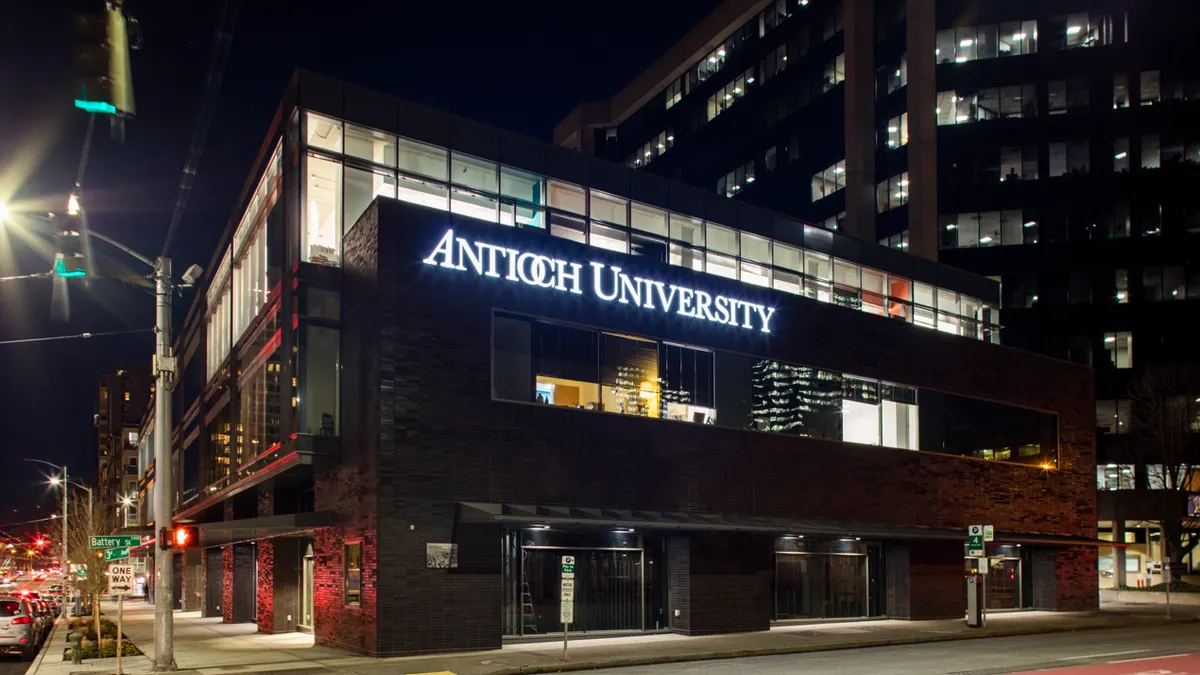
Antioch University administrators are facing “uncertainty” and “conflicting directives” amid a legal fight over the institution’s leadership and control, according to an internal email Friday from the chair of Antioch’s advisory board of governors, Steve Crandall.
Since late August, Antioch leaders have been locked in a legal battle with the Coalition for the Common Good, the organization it co-founded with Otterbein University in 2023 to bring together colleges with similar missions to collaborate around academic programming, shared services and other areas.
Late last week, John Comerford — who is president of both CCG and Otterbein— told Antioch University administrators to remove a website stocked with documents and letters related to the dispute between Antioch and CCG.
As of late Monday afternoon, the Antioch website was still live despite Comerford demanding in an email obtained by Higher Ed Dive that administrators take it down by Friday evening.
Comerford further instructed administrators to halt all communications with stakeholders about the conflict or on behalf of the Antioch board of governors, including through town halls and alumni communications, according to his email from Friday. Moreover, he has attempted to put Antioch President Lori Varlotta on administrative leave, Varlotta confirmed to Higher Ed Dive on Monday.
In late August, CCG sought to dissolve the Antioch board of governors, as well as assert control over the university’s bank accounts. Those actions prompted a lawsuit from Antioch’s board of governors, which described CCG’s actions as a “hostile takeover.” Comerford and CCG board leaders have also attempted or threatened to fire Varlotta multiple times since the summer.
An ongoing dispute
Antioch reincorporated as CCG in 2023 to launch the coalition and is legally listed as a division of it. Comerford and CCG leaders have argued that gives the CCG board total fiduciary authority over Antioch.
The leaders of Antioch, however, strongly oppose that interpretation. They have pointed to numerous items in the coalition’s founding documents that give the university’s board of governors and its standing committee on the CCG board oversight of the university’s operations.
Moreover, current and former Antioch officials say Antioch’s decision to reincorporate as CCG was meant to be a temporary solution to help win regulatory approval of the coalition’s structure.
An Ohio state court initially blocked the coalition from accessing Antioch’s accounts and dissolving its board. But the court later concluded the university’s board of governors didn’t have standing to sue, as it wasn’t a party to CCG’s bylaws. In making that determination on Sept. 28, it also rejected the Antioch board’s request for a preliminary injunction against CCG and let a restraining order lapse, while leaving in place a directive that Antioch and the coalition enter mediation.
A second complaint was quickly filed the day after the decision, this time from one of the four members of Antioch’s standing committee on the CCG board. Antioch leaders have argued that CCG cannot dissolve the university’s board without prior approval from the Antioch standing committee.
A hearing in the case is scheduled for Friday.
Despite the new complaint and renewed request for an injunction, Comerford said in his Friday email to four high-level Antioch administrators ithat “all court restrictions on the authority of the CCG Board and President have been lifted” following the prior ruling in the board of governors’ lawsuit.
Crandall said in his email Friday to stakeholders that the board, Varlotta and other university leaders would continue communicating and providing direction to the university until “we get further orders from the court.”
“With a court hearing approaching and a proposed mediation in the works, we urge CCG to avoid further disruptive changes, including shutting down communications that help the Antioch community understand what is happening,” Crandall wrote. “We continue to challenge CCG’s asserted authority through counsel and the court.”
In an emailed statement Monday, the CCG board said “the Coalition for the Common Good has taken a number of steps to return to good governance” following the court ruling last week. It also said Varlotta was on paid administrative leave while it reviews “performance-related matters.”
Antioch and CCG were scheduled to begin mediation on Monday afternoon, according to Varlotta, who told Higher Ed Dive on Monday that the university’s leadership team and board of governors “believe mediation is the best path forward.”
Officials at Antioch first conceived of launching an innovative university coalition years ago and in 2023 found their first partner in Otterbein.
Antioch and Otterbein coexisted amicably within the coalition for a time. Antioch and CCG’s dispute began earlier this year, around the time when Varlotta and other Antioch administrators issued detailed findings about the coalition’s potential negative financial impact on the university.
Since August, Varlotta and Crandall have openly advocated for a break from the coalition’s governance structure.