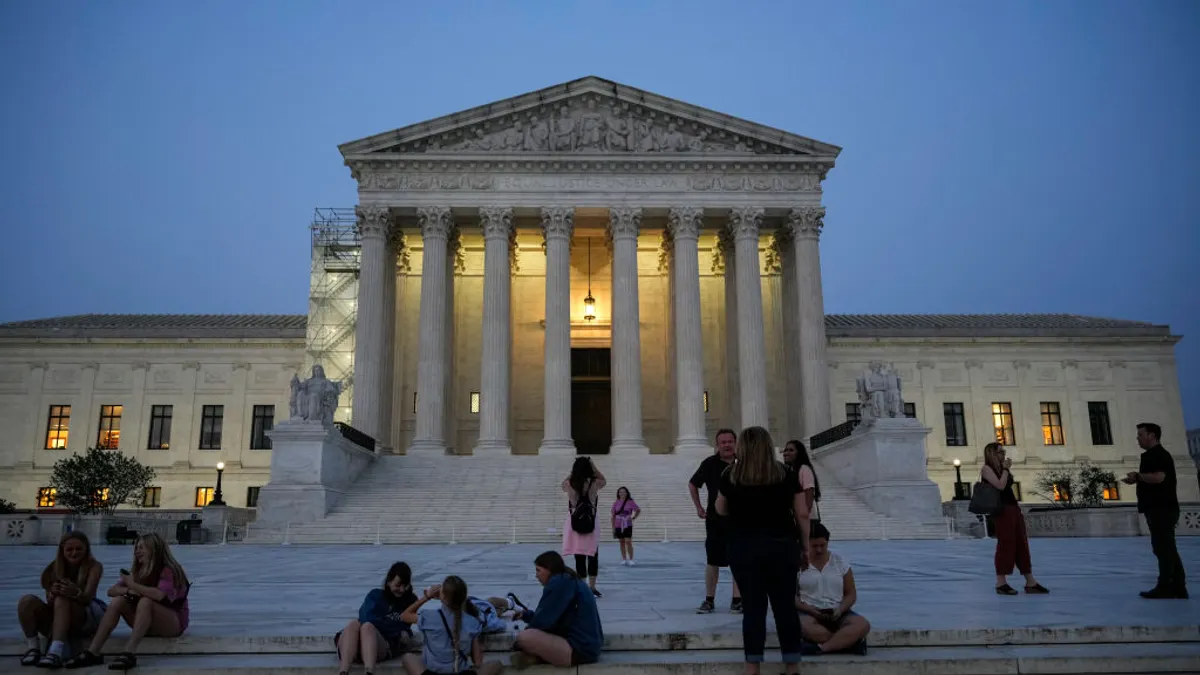
A critical question facing the U.S. Supreme Court in its 2026-27 term is whether employees of federally funded educational institutions can sue their employers for sex discrimination under Title IX.
On Nov. 30, the justices will hear arguments in Crowther v. Board of Regents of the University System of Georgia, a case that experts agree will have big implications on future litigation brought by employees against colleges and universities.
Georgia Institute of Technology, more commonly known as Georgia Tech, fired its head women’s basketball coach MaChelle Joseph in 2019, less than two months after she filed an internal complaint alleging that the university was discriminating against her and her sports program by not providing the same resources that it did for the men’s basketball team.
The university countered that it terminated Joseph following an independent investigation that revealed certain players felt bullied by her.
In 2020, Augusta University — also part of the University System of Georgia — reassigned and later decided against renewing the contract of fine arts professor Thomas Crowther after a Title IX investigation into an anonymous sexual harassment complaint. Crowther claimed that the university ignored numerous witness statements in his favor.
Both Crowther and Joseph sued the system’s regent board alleging sex discrimination under Title IX, which prohibits sex-based discrimination in federally funded education programs. The Atlanta-based 11th U.S. Circuit Court of Appeals consolidated the cases and dismissed both Title IX claims, finding the 1972 law did not provide individuals with the right to sue for sex discrimination in employment.
Most other federal appellate courts disagree, with eight circuit courts having ruled that Title IX permits employees to sue the institutions that employ or employed them. The 5th and 7th Circuits are the other appellate courts that have blocked such lawsuits.
But how the Supreme Court will handle this case is far from clear.
Not its first rodeo
This won’t be the first time the Supreme Court has ruled on Title IX employee claims. The high court ruled 5-4 in 2005 that an Alabama high school girls’ basketball coach and gym teacher could proceed with his Title IX lawsuit in Jackson v. Birmingham Board of Education.
Roderick Jackson had complained to supervisors about the unequal funding and access to facilities and equipment his team received but was allegedly ignored. He began receiving negative performance reviews and ultimately lost his job as the girls’ coach though he remained employed as a teacher. He argued officials retaliated against him in violation of Title IX for reporting sex-based discrimination.
To Miriam Becker-Cohen, the Supreme Court’s holding for Jackson should make Crowther a rather easy case. Becker-Cohen is senior appellate counsel at the Constitutional Accountability Center, a nonprofit law firm and think tank, and is the lead author of an amicus brief supporting the plaintiffs.
There is no limitation on who can bring a private lawsuit in any Title IX case, according to Becker-Cohen. “Jackson only makes that case even stronger because Jackson involved a school employee,” she said.
If anything, Becker-Cohen contended that Jackson was a harder case because the court had to resolve the issue of whether it involved intentional sex discrimination. But there is “no question” the acts complained of in Crowther are intentional sex discrimination, she said.
But Jon Israel, a management-side sports and employment law attorney with Foley & Lardner in New York, suggested the cases have differences even though both involve coaches.
The finding in Jackson of an implied right to sue “makes it a little more distinguishable” than the Crowther case, which is dealing with a direct right to sue for nonstudents at higher educational institutions.
Gregory Garre, who served as U.S. solicitor general during the George W. Bush administration and now practices with Latham & Watkins, agrees there is a distinction. Garre filed an amicus brief in the case on behalf of the National School Attorneys Association supporting the University System of Georgia’s regents board.
“When it comes to Title IX, what they’re asking the court to do here is really dramatically expand the right from its traditional focus, which is on sex discrimination against students, into the realm of employment discrimination against employees of schools,” Garre told Higher Ed Dive.
Garre added that Title VII of the Civil Rights Act, which Congress amended shortly before passing Title IX, applies to employees of educational institutions as well as other organizations, meaning they can sue over sex-based employment discrimination under that statute. And, he called that timing significant.
“The statutory history here is a pretty compelling indication that Congress did not intend for Title IX to cover employment discrimination because Congress had passed Title VII [amendments] just months before it enacted Title IX.”
As a result, both Garre and Israel have said they think Title VII provides ample recourse for employees, such as those in the Crowther case.
But Becker-Cohen disagreed. “At least for some employees of federally funded institutions, Title VII isn’t going to be an option,” she said.
While the remedies may overlap, Becker-Cohen said Title VII has a much tighter statute of limitations, which can be as short as 180 days, than Title IX, which has no set limitations period — so courts rely on the most analogous state law limitations period.
She also said Title VII requires individuals to exhaust other avenues, such as filing a complaint with the U.S. Equal Employment Opportunity Commission before they can sue, among other procedural roadblocks not present in Title IX.
And that’s not all, according to sports law professor Barbara Osborne, who has represented colleges and universities on compliance issues.
“Title VII is strictly based on the sex of the employee. So that would not include what the typical Title IX claims are. They are different causes of action,” said Osborne, who teaches at the University of North Carolina at Chapel Hill.
In the typical Title IX employment case, she explained, the person suffering the negative employment action is not necessarily discriminated against because of their sex but rather for complaining about sex discrimination in the athletics program, which she noted that both Jackson and Joseph — the former Georgia Tech coach — clearly did.
Osborne also pointed out that Title IX regulations contain a section related to employment. “Why was it necessary to create regulations related to employment if there weren’t situations within education that might be different than normal employment situations?”
The Supreme Court could have said Title IX remedies were not available for employment retaliation in Jackson and declined to do so, Osborne and Becker-Cohen both were quick to note.
But more than two decades later, Crowther comes before a much different court, with the author of the Jackson opinion, former Justice Sandra Day O’Connor, and others in the majority, having long since retired or died.
The college athlete conundrum
College athletes are not considered employees. But that day could be coming in light of the massive changes affecting college sports in recent years, including the influx of name, image and likeness money.
As a result, how the Supreme Court resolves Crowther could affect college athletes themselves should they someday be deemed employees of the institutions whose teams they play on.
“If Title IX includes employees, the class of potential Title IX plaintiffs is going to be expanded dramatically,” said Garre, adding that the possibility of college athletes being considered employees would “certainly create new wrinkles” in litigation.
One of those wrinkles for college-athletes-as-employees could become a case of “be careful what you wish for” according to Israel, if the Court rules against the plaintiffs.
“If the student-athletes are treated as employees, and Crowther decides that Title VII is the exclusive remedy for employees then they’re in that Title VII world — not Title IX.” Israel said.
He contended that some disparate treatment arguments — that an institution is treating female athletes differently than male athletes playing revenue-producing sports, such as football or basketball — might effectively disappear under Title VII as a result.
According to Israel, that’s because a college gymnast’s work, for instance, differs from that of a football player so they would not be similarly situated under Title VII. “If you put it in a different context, a line worker versus an executive, they wouldn’t have the same compensation,” the sports law attorney said.
But Osborne vehemently disagreed.
“The job description of a student-athlete would be virtually identical no matter what team they participate on, right?” she said. “They’re going to be expected to go to class. They’re going to be expected to go to practice, follow the nutrition program and whatever else. The job description isn’t (to) be able to perform in front of 15,000 fans. That’s not what the job is.”
Becker-Cohen acknowledged that if the Supreme Court were to rule for the system’s regents board, it would leave student-athletes and others with no remedy for sex discrimination unless they could make out a claim under Title VII.
“To the extent that the Court carves out college employees from the reach of Title IX’s private right of action, if the class of individuals who are considered college employees increases, that will just harm more people,” Becker-Cohen said.